Compression is the most misunderstood tool in mixing. Most amateur engineers reach for it to make things louder. Professionals use it to make things consistent — so the listener hears everything they need to hear, evenly, without the loud moments overwhelming the quiet ones or the quiet moments getting lost.
If EQ manages the frequency spectrum — how your tracks are distributed across high to low — compression manages the amplitude spectrum, the range between the quietest and loudest moments of any single signal. The goal isn't to flatten that range to nothing. The goal is to control it, so the natural dynamics of the performance still come through but the level never spikes or dips out of usefulness.
Threshold and ratio: the core parameters
Two controls do the heavy lifting on any compressor. The threshold sets the level at which the compressor begins to work — any signal louder than the threshold gets reduced; anything quieter passes through untouched. The ratio determines how aggressively that reduction happens.
A 4:1 ratio means for every 4 dB the signal rises above threshold, only 1 dB comes out the other side. So if the input is 4 dB over threshold, output is 1 dB over. If input is 8 dB over, output is 2 dB over. The compressor is squeezing the dynamic range above your threshold by that ratio.
Typical starting points: 2:1 for transparent levelling on vocals and acoustic instruments, 4:1 for general control on drums and bass, 6:1 or higher when you specifically want the compression to be heard as character (heavily-compressed pop vocals, smashed drum buses for rock).
Attack and release: the feel controls
Threshold and ratio set how much. Attack and release set the feel — the groove, the punch, the breath. They determine what the compressor catches and what it lets pass.
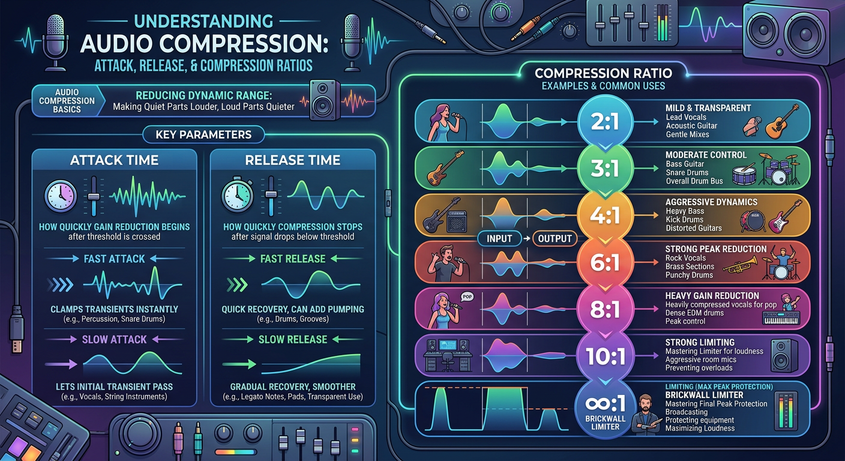
Attack times
A fast attack (0.1 to 5 ms) catches the sharp initial transient of every note. Good for taming aggressive peaks, protecting your mix bus from clipping, and squashing percussive elements you specifically want to sound dense rather than punchy.
A slow attack (20 to 50 ms) lets the transient pass uncompressed before the compressor clamps down. This preserves the punch and snap of percussive elements — kick, snare, bass guitar — while still controlling the sustain that follows. Most professional drum compression uses slow attack times for this exact reason. If your kick sounds flat and lifeless, your attack is probably too fast.
Release times
A fast release means the compressor disengages quickly after the signal drops below threshold. If it's too fast, you get a pumping or breathing artifact between notes — the compressor working overtly, drawing attention to itself.
A slow release means the compression sustains for a longer period after the signal drops. If it's too slow, the compressor stays clamped down between notes and dulls the natural dynamics of the performance.
The groove test: Set your release time so the gain reduction meter pumps in rhythm with the tempo of the song. The compressor should breathe with the music, not fight it. If your meter is flickering randomly out of sync with the beat, your release time isn't matched to the song.
Parallel compression: power without sacrifice
Here's the move that solves the central dilemma of compression: heavy compression produces density and power, but destroys the natural transients that give music its life and excitement. You want both. Parallel compression lets you have both.
The setup: send a copy of your track to a parallel bus. On that bus, apply heavy compression — fast attack, high ratio, aggressive gain reduction. Then blend that heavily-compressed signal underneath the original uncompressed track. You get the dense, sustained body from the compressed bus combined with the natural punch and transients from the original.
Where it shines:
- Drums: Adds weight, sustain, and fullness without losing the attack of the sticks. The "New York compression" technique on drum buses is exactly this.
- Vocals: Increases intelligibility and consistency without producing the squeezed, over-compressed sound that aggressive serial compression creates.
- Bass: Provides harmonic richness and even sustain without collapsing the low-frequency body of the instrument.
The bottom line
Compression should be felt, not heard. If you can obviously hear the compressor working — the pumping, the squashing, the unnatural sustain — you're using too much. The professional standard is compression that makes everything feel more cohesive without drawing attention to itself.
A good test: bypass your compressor and play the section. Then re-engage and play it again. Does the music feel more controlled and consistent without losing its energy? You're using the tool correctly. Does it sound smaller, flatter, or less alive with the compressor on? You're using too much, or your attack times are too fast. Adjust and try again.
This is one chapter of The Professional Audio Mixing Blueprint
The full book covers 12 chapters — monitoring, gain staging, EQ, compression, reverb and delay, automation, psychoacoustics, modulation and saturation, mixing for genre, and the complete diagnostic protocol I use on every session. Available now on Amazon.